In an effort to move outside of my relative comfort zones for classification (DDC/LCC), I want to examine a classification schema that has been lurking in the back of my mind for the past month and a half. I cataloged the Carter's complete set of Diderot's Encyclopédie about two months ago, something I talk about on my blog here.
The Encyclopédie is considered by many to be one of the apogees of the enlightenment, and a catalyst for the French Revolution. The ideas of the enlightenment are well represented in the classification of human knowledge presented in the Encyclopédieʼs classification scheme: theology is placed under philosophy, and the knowledge of God is only a few points above black magic. As one can imagine, this caused a great deal of criticism in 18th century Catholic France, so much so that in 1759, the king suspended the publication rights for the work. However, work continued in secret - and the copy I cataloged represents this, as the later volumes state that they were published in Amsterdam. The classification scheme of the Encyclopédie was inspired by Francis Baconʼs Advancement of Knowledge, and classified all knowledge into three major categories: memory, reason, and imagination. Here's an image of the table itself:
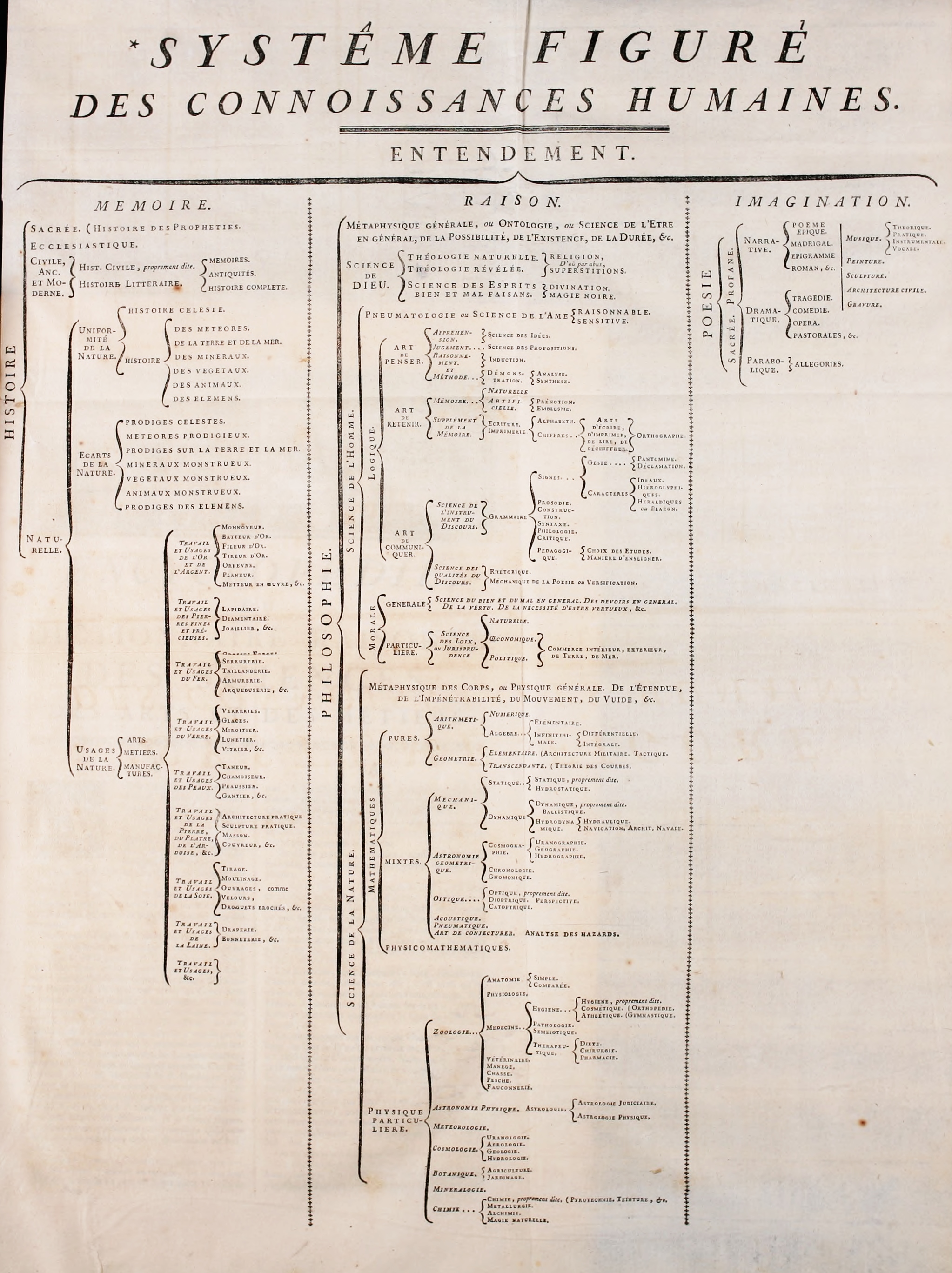
To me, this scheme is indicative of classification schemes across time: they are always reflective of the time in which they are used. I very seriously doubt that a major library would employ Bacon's or Diderot's classification scheme today, but they do give us insight into the time in which the scheme was created and employed. Thinking about the article for this week, Diderot's scheme is certainly hierarchical, with the classes organized in trees. This helps to give some form of definition to the classes within the scheme (something I hope the semantic web will go even better) by showing some relationships and contextual information. However, the scheme does portend to be comprehensive - which, I think is the downfall of most classification schemes. By their very nature, classification schema are not particularly hospitable to the inclusion of new knowledge, that is, schema are hard to fit new knowledge into effectively. For example, where would one put computers in Diderot's scheme? Under Metiers/Manufactures? Under Mathematiques? What about the Internet?
I suppose I would say overall that this scheme is successful for its time, but is reflective of larger problems within classification schemes. All in all, it is still interesting and revelatory of the thought of a time and a group of people.
What do you think? How do you classify "stuff? I'd love to know!

No comments:
Post a Comment